Why Franchise Field Visits Don't Scale and What Replaces Them
 Revscale AI Team5 min read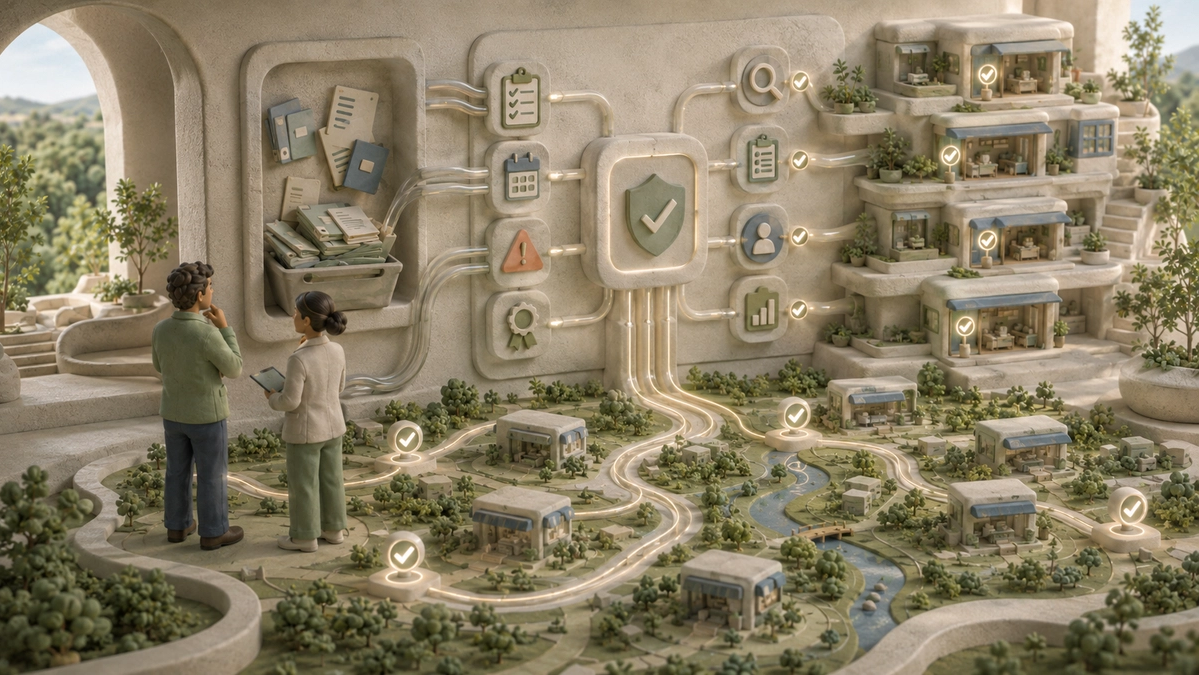
A regional FBC at a 180-unit service brand drives 38,000 miles a year, runs through three rental cars, and visits each location in her territory twice. By the time she walks in the door, the franchisee already knows what's broken. The visit becomes a conversation about things the home office could have flagged six weeks earlier. She leaves with a list of action items the franchisee may or may not implement, and the cycle repeats.
This is the field operations model most franchise networks still run on. It worked at 25 units. It strains at 100. It quietly breaks somewhere past 150.
The math behind the field model
The current industry benchmark is roughly one Franchise Business Consultant (FBC) per 34 franchisees. Fully loaded, an FBC costs between $90,000 and $140,000 a year once you include salary, benefits, travel, and tools. Travel alone runs $1,600 to $1,800 per trip, with average US business airfare at $705 and hotel rates near $165 a night. A field consultant covering 30 or more locations spread across a region spends 40 to 60 percent of working time in transit.
Run the arithmetic on a 200-unit brand. You need six FBCs just to maintain the standard ratio. That's roughly $700,000 a year in salary plus another $300,000 in travel before any of it touches a franchisee's P&L. The math gets worse, not better, the more you grow.
What a field visit actually produces
Most field visits are a backward-looking conversation. The consultant walks the floor, reviews recent numbers, checks brand standards, hears the franchisee's complaints, and leaves a punch list. The industry benchmark for healthy field support says 70 percent of consultant time should be proactive coaching and 30 percent reactive troubleshooting. In practice, most networks invert that ratio. By the time an FBC arrives, the franchisee is already underperforming, and the visit is forensic, not preventive.
The healthy benchmark is 85 percent of field recommendations implemented within 60 days. Most networks miss it by a wide margin. A field visit captures one moment. A franchise problem unfolds across weeks.
Why ratios get worse, not better, with growth
The natural reflex when a network scales is to hire more FBCs. That makes a one-time problem worse on three vectors at once.
First, geography compounds. Adding 40 locations across three new states means existing consultants either inherit longer routes or you split territories and double the staffing line. Travel cost per visit moves up, not down.
Second, consultant tenure declines. Field roles burn out fast. Constant travel and limited career progression mean turnover is high, and a new FBC needs 6 to 12 months to learn the network well enough to add value.
Third, the franchisee experience flattens. The same franchisee may see three different FBCs in five years. Continuity, which is the entire point of having a coach, gets sacrificed every time you re-org the field team.
You don't outgrow this problem by hiring. You outgrow it by changing what an FBC does.
The data layer that replaces windshield time
The replacement is not a remote field consultant on Zoom. That's still a meeting, still reactive, still constrained by calendars.
The replacement is a continuous data layer that watches every location daily and surfaces the three or four issues that actually matter, in priority order, with context attached. POS data, labor data, NPS, mystery shop scores, marketing spend, lead response time, royalty pacing, and inventory variance all roll into one signal per unit per day. When the signal moves outside a defined band, the system pings the right FBC with the specific issue, the data behind it, and a recommended intervention.
This shifts the consultant from windshield time to coaching time. A 30-unit FBC who spent 50 percent of her week driving now spends 80 percent of her week on focused conversations with the six to eight units that need her this week. The other 22 are not ignored. They're being watched by software that doesn't get tired and doesn't miss a quarter.
The math changes accordingly. Networks moving to an intelligence-led field model push FBC ratios to 60 to 80 locations per consultant while improving the proactive-to-reactive coaching balance, not degrading it. That's roughly half the field headcount for the same coverage.
What stays in-person and what doesn't
The temptation is to eliminate field visits entirely. That's the wrong answer.
Three things still require physical presence:
- New unit opening reviews in the first 90 days, where in-person presence builds the operator relationship that determines five-year performance.
- Brand standards audits where pattern recognition needs human eyes (cleanliness, employee posture, customer interactions).
- Recovery interventions where a franchisee is in serious financial or operational distress and a personal visit changes the dynamic.
Everything else (monthly reviews, quarterly business plans, ad-hoc troubleshooting, training refreshers, KPI conversations) runs better on a cadence driven by data rather than a calendar. The right question is not "when do we visit," it's "what signal triggers a visit." The two answers produce completely different field operations budgets.
How to phase this in without disrupting your network
Networks that try to flip the model in one quarter create franchisee panic. The phased version takes three quarters.
Quarter one: deploy the unit-level data layer. Get every system feeding into one place. Build the signal logic with your top FBCs, who already know intuitively what they're looking for.
Quarter two: shadow-run it. FBCs keep current visit cadence. The signals feed them weekly priority lists. They notice that the system flags the same units they would have prioritized, plus several they would have missed.
Quarter three: shift the cadence. Field visits become event-triggered, not calendar-triggered. FBC territories expand. Headcount flattens or contracts through attrition rather than layoffs.
By month nine, the field model has changed without a single bad town hall.
The consequence of not changing the model
Networks that stay on the legacy field model don't fail visibly. They fail through margin. Field operations becomes a fixed cost that grows linearly with units, while franchisee performance variance widens because no one has the data to spot a slow drift until it shows up in royalties three months later.
At Revscale, the franchise networks we work with run their field operations on continuous intelligence rather than scheduled windshield time. The result is fewer field hires, lower travel cost, and a proactive-to-reactive ratio that no in-person model has produced at scale.
The field visit was never the value. The right intervention at the right moment was. Networks that act on this distinction get a structurally cheaper, structurally better support function. Networks that don't get to keep paying for rental cars.